When evaluating basketball legends, traditional statistics only tell part of the story. RealVPM (Real Value Per Minute) takes this further by measuring the statistical value players generate each minute they are on the floor. By applying the league’s median salary as a baseline, we can estimate the financial value per game (FVPM) that each player’s production represents.
It’s important to note that this metric captures statistical on-court value only — it does not measure off-court revenue, leadership, or intangible impact. With that in mind, let’s break down LeBron James’ legendary career into segments and compare his FVPM to some of the greats of his era.
Cleveland I (2003–2010)
- Minutes per game: 40.3
- ATT VPM: 80.7
- DEF VPM: 57.2
- Actions per minute (APM): 1.28
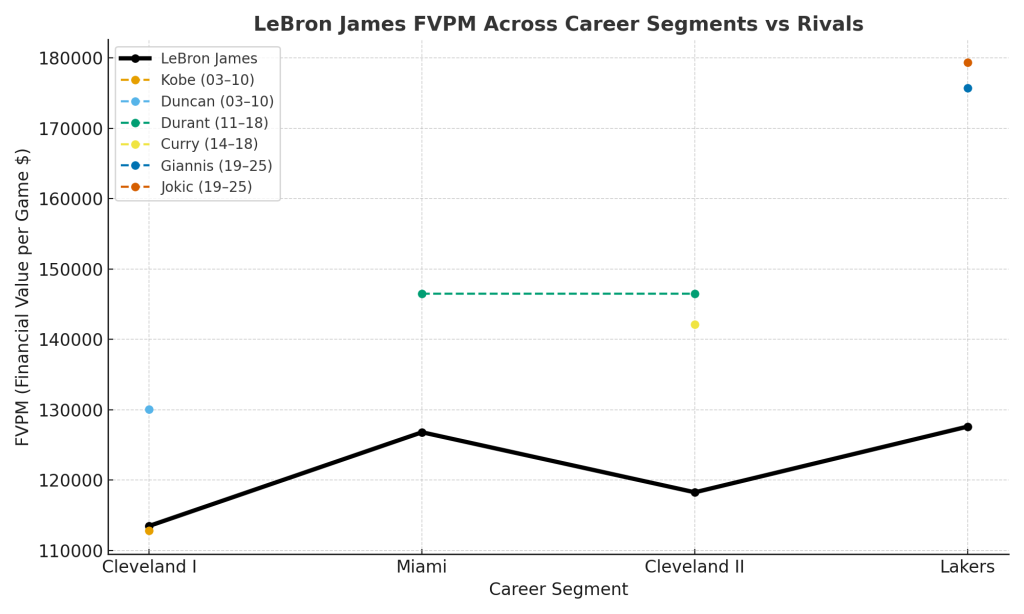
- FVPM: $113,478
LeBron entered the league as a teenager and immediately became a franchise saviour for a struggling Cavaliers roster. Playing heavy minutes and carrying immense usage, he produced elite offensive and defensive contributions. Despite limited supporting talent early on, his FVPM already rivalled the league’s best.
Comparison:
- Kobe Bryant (2003–2010): 39.1 mpg, FVPM $112,784
- Tim Duncan (2003–2010): 33.9 mpg, FVPM $130,084
Kobe provided similar offensive brilliance, but Duncan’s two-way balance and efficiency gave him a higher FVPM, even with fewer minutes.
Miami Heat (2010–2014)
- Minutes per game: 38.0
- ATT VPM: 98.1
- DEF VPM: 57.4
- APM: 1.26
- FVPM: $126,794
In Miami, LeBron reached peak efficiency. With Dwyane Wade and Chris Bosh sharing the load, he didn’t need to play quite as many minutes, but his production per minute rose. His improved shot selection and defensive versatility fueled an elite statistical prime.
Comparison:
- Kevin Durant (2011–2018): 36.8 mpg, FVPM $146,462
Durant, along with players like Steph Curry, helped redefine scoring efficiency in this era. While LeBron still dominated, their shooting gravity and offensive explosions nudged their FVPM above his peak Miami levels.
Cleveland II (2014–2018)
- Minutes per game: 36.6
- ATT VPM: 90.1
- DEF VPM: 56.2
- APM: 1.34
- FVPM: $118,256
Returning to Cleveland, LeBron had star teammates in Kyrie Irving and Kevin Love, but the team faced challenges with injuries and an evolving NBA. Despite a somewhat reduced load compared to Miami, his playmaking and leadership still translated into an elite FVPM. His Finals battles against the historically great Warriors further amplified the weight of his contributions.
Comparison:
- Steph Curry (2014-2018): 33.9 mpg, FVPM $142,127
- Durant’s Warriors years overlapped here, highlighting just how difficult LeBron’s Finals matchups were.
Los Angeles Lakers (2019–Present)
- Minutes per game: 35.2
- ATT VPM: 101.7
- DEF VPM: 54.7
- APM: 1.37
- FVPM: $127,600
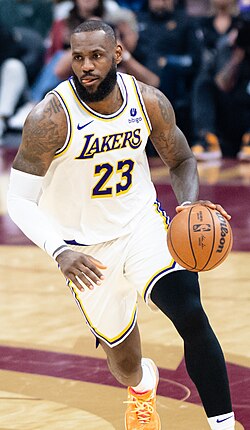
Even into his early 40s, LeBron continues to defy time. His efficiency as a scorer and playmaker has remained elite, and his FVPM in Los Angeles matches his Miami peak. The ability to adapt to new teammates and roles — including winning the 2020 title in the bubble — cements his remarkable longevity.
Comparison:
- Giannis Antetokounmpo (2019–2025): 33.0 mpg, FVPM $175,701
- Nikola Jokić (2019–2025): 33.7 mpg, FVPM $179,321
The new generation has pushed statistical efficiency even higher, with Giannis’ two-way dominance and Jokić’s unprecedented offensive engine setting new FVPM marks.
Conclusion
LeBron James’ career FVPM arc tells the story of both dominance and adaptability:
- Cleveland I: High-volume superstar.
- Miami: Peak efficiency and championship prime.
- Cleveland II: Sustained excellence.
- Lakers: Longevity and adaptability, still elite into his late 30s.
While players like Durant, Curry, Giannis, and Jokić post higher peaks in specific areas, LeBron’s sustained elite FVPM across two decades sets him apart. His career shows not just greatness in one era, but the ability to remain financially and statistically valuable across multiple generations of NBA stars.