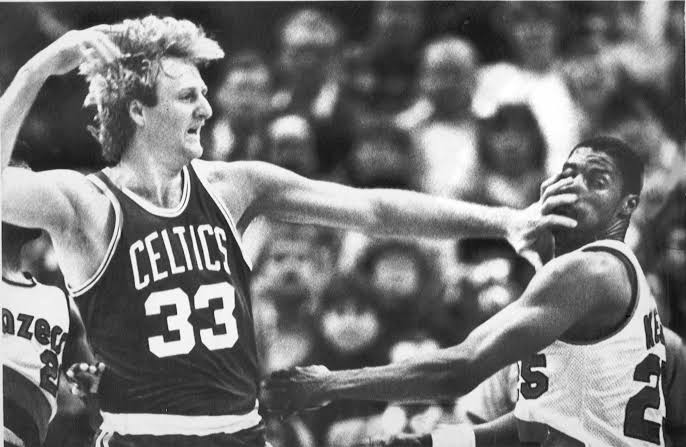
Larry Bird along with Magic Johnson are credited with saving the NBA when - in the same era - they led the two most historic franchises in NBA history, the Boston Celtics and Los Angeles Lakers. In doing so, they also created a personal rivalry that is almost unmatched in any sport. When all was said and done, they walked home with eight Championship rings and eight Most Valuable Player awards between them.
Magic is widely considered as the greatest ever Point Guard but how about Bird at small forward? Where does he sit amongst the top echelon of small forwards? It’s always hard to compare eras but sometimes the evidence is so striking that it’s hard to deny.
Rings are a team achievement and awards are often opinion-based yet stats are often determined by the rules of an era, the opposition, teammates or even the style of play of that era. Trying to work through all this and come out with a definitive answer is a challenge. Using Real Value Per Minute in conjunction with more traditional stats will help us to paint a clearer picture of where Larry sits in the Small Forward Parthenon.
First, let’s start with the traditional stats (points, rebounds, assists, blocks, steals and shooting percentage). Now Bird only played eleven full regular seasons with injuries curtailing another two so we are going to focus on per game averages not totals. After all the question is who was the greatest not who played the longest. But we have more than enough sample size to judge the calibre of the Hick From French Lick’s game.
No other small forward is ranked as high amongst other small forwards across the statistical board as Bird. Let’s start with scoring.
SCORING
Bird averaged 24.3 ppg (23.8 ppg in the playoffs) in the regular season which puts him fourth overall amongst small forwards behind Kevin Durant, LeBron James and Elgin Baylor. While this is impressive, more impressive was the way that he could kill you. No small forward had the arsenal that Larry had with the deadly accuracy. He could beat you from beyond the arc, midrange, in the post and at the line.
Larry Bird is the only small forward to have multiple 50/40/90 seasons, which is 50% FG, 40% 3PT, and 90% FT, since the three point line was introduced. He accomplished this feat in the 1986/87 and 1987/88 seasons but he also did it in the playoffs in 85/86 when he led the Celtics to the Championship over the Houston Rockets. Kevin Durant is the only other small forward to join this club and Steve Nash is the only other player to have done this in multiple seasons. Of the 9 players to have achieved this, he has the highest field goal percentage at 53% (Mark Price also had a 53%).
Bird averaged the sixth most field goal attempts a game at 19.6. For context Durant and James average 18.8 and 19.9 respectively while Baylor averaged 23.8. This does require even more context though. Baylor played in an era without three pointers with Durant and James playing in the era of threes and Bird playing with the three point line but it wasn’t a big part of the way the game was played . As a result, Bird only averaged 1.8 attempts for his career including three seasons where he took less than one three a game. Compare this to Durant and James who take 5.1 and 4.5 threes a game.
Let’s explore Bird’s three point shot more closely and why he’s arguably the best long distance marksmen amongst the small forwards and one of the best out of any position. The small forward position does have some exceptional marksmen such as Durant, Dale Ellis, Glen Rice, Peja Stojaković and Jason Kapono, among many others.
Of the eight seasons he averaged over 1.5 attempts a game, he averaged over 40% from three six times. For comparison, Durant has three seasons out of eleven (only counting seasons where he’s played over half the scheduled games) shooting over 40% and the fewest shots he’s attempted from distance was 2.6 in his rookie season. Looking at Bird’s career shooting, his percentage was better when he shot in volume but even shooting over 40% while attempting less than two shots a game is an impressive feat because you’re really getting only one to two chances a game rather than shooting yourself into a rhythm.
He also won three consecutive three point shooting contests which is only matched by Craig Hodges. In those three wins, he beat Ellis and Hodges three times and Mark Price once with those three going on to win the following six contests, combined.
Much like Steph Curry, Bird was his side’s main scoring threat and therefore came in for the closest treatment from the defence which makes his shooting percentages as impressive as Curry’s. Bird was known to even tell the opposition where he was going to shoot from even in clutch situations.
DEFENDING
Defense is not the first thing you think about when you think about Larry Bird but he did make three consecutive All-Defensive Second Teams from 1982 to 1984. It was only the defensive play of Bobby Jones aka The Secretary of Defense who made eleven All-Defensive teams in his 12 year career that beat him out for the first team. Arguably what slowed Bird down defensively was the back injury he picked up mid-1985 which he carried with him until his retirement.
His high basketball IQ and tenacious competitive spirit helped him hold his own especially when it came to the passing lanes where he was adept at picking off plays and reading the opposition offense. Is he the best defensive small forward? No, but he was certainly no liability and is 12th all-time among small forward for blocks and 5th all-time in steals.
For comparison, Durant who is 5th all-time for blocks has no All-Defensive Team selections. LeBron James has six selections in his eighteen seasons and is 17th All-time for blocks and 9th All-time in steals.
REBOUNDING
Elgin Baylor averaged the most rebounds of any small forward with 13.5 per game. Bird is 4th with an even 10.0 per game. What is most impressive is that not only did he do this in the era of the big man but he did so with 2.0 offensive rebounds per game. To put this in perspective, LeBron James has played 515 more games but has 175 less offensive rebounds. Durant and Bird have played almost the same amount of games but Durant has nowhere near as many rebounds. James and Durant are 13th and 14th amongst all small forwards, respectively.
PLAYMAKING
Larry Bird’s biggest rival was none other than arguably the greatest playmaker ever, Magic Johnson. However, Bird’s own playmaking is often overlooked. He possessed remarkable court vision, able to hit teammates with no look passes, or instinctive taps, could thread the eye of the needle to split defences with ease.
He’s 2nd all-time for assists per game with LeBron James the small forward with the highest assists per game average. They are both high in the turnover lists too. LeBron has the most turnovers per game while Larry has the third most. It could be argued that despite his great playmaking ability, that Bird did play a more traditional forward role as opposed to a LeBron who plays more as a point forward. This is reflected in their usage rate with Bird having 26.4% usage rate to LeBron’s 31.5%.
Bird had great point guards like Tiny Archibald and Dennis Johnson on his team and they functioned as the traditional facilitating point guards more than the point guards of today who take on more of a scoring role. So for Bird to average the amount of assists he did as well as being the main scoring option as a traditional small forward, is testament to his impressive all-round game.
VALUE PER MINUTE
Now let’s take all his points, rebounds, assists, steals, blocks, turnovers and personal fouls and compare his statistical value to other small forwards. First, we look at the successful and unsuccessful shot attempts from three-point and two point range as well as free throws which are weighted by the league average (we’ve used the 2019/20 league averages). The same is done for the other statistics so volume and difficulty are important when valuing each stat.
We will break the value of Larry and other prominent small forwards into three groups; defense, offense and overall. The higher the score the more statistical value a player provided. It’s important to remember that the higher success rate and higher the volume of a statistic, the lower its value will be for successful attempts; conversely, unsuccessful attempts will have a higher negative value.
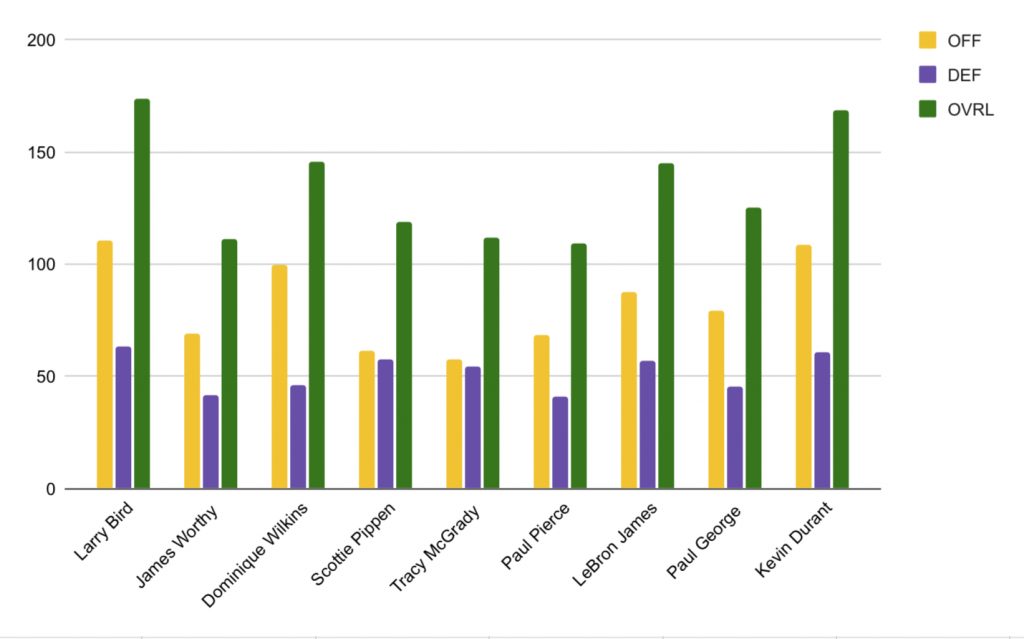
As we can see from the graph above, Bird provided the most statistical value per minute spent on the floor in every category. He didn’t have any glaring weaknesses to his game. What he might’ve lacked in athleticism, he made up for in fundamentals, IQ, and his competitive spirit.
GENERAL
Let’s look at some more general facts of Bird’s career. He was the last player to win three consecutive MVP Awards, and the only other players to do it before him were Wilt Chamberlain and Bill Russell.
The Celtics were coming off a 29-53 season when they drafted Bird in 1979. Larry was the only major change to the roster before the 1979/80 season. He helped the Celtics make a 32 win turnaround in his first season and giving them the best record in the league. They eventually lost to Julius “Dr J” Erving’s Philadelphia 76ers in the Eastern Conference Finals but the Celtics were now a team on the rise.
In only his second season, he led a rookie Kevin McHale, a veteran Tiny Archibald and the newly-acquired Robert Parish to a 62 win season and the NBA Championship. They beat the Sixers in seven games and the Houston Rockets in six. Cedric Maxwell won the Finals MVP but Bird finished the series averaging over 15 points, 15 rebounds, 7 assists and 2 steals.
He would go on to win both Finals MVPs in his other two Championships.
Over his eleven full seasons, his teams won 60 or more games six times, and 50 or more games eleven times. The season he only played six games, the Celtics had a record of 42-40, this was sandwiched between 57 win and 52 win seasons.
Finally, let’s look at the caliber of small forwards over the course of Bird’s career. Who were the main competitors in the small forward position during Bird’s career? Well here are some names you might’ve heard of Julius Erving, Jamaal Wilkes, Marquise Johnson, Walter Davis, Adrian Dantley, James Worthy, Mike Mitchell, Bernard King, Dominique Wilkins, Alex English, Mark Aguirre, Kiki Vandeweghe, Scottie Pippen, Chris Mullin, Xavier McDaniel and Dennis Rodman to name just a few.
CONCLUSION
Bird’s career was cut short and hampered by a chronic back problem halfway through his career but even so the man was able to carve out Hall of Fame career that exemplified excellence in every facet of the game. He played in a tough era that was not built as much for the offensive player as we see today. He faced Hall of Fame and All-Star level competition on a nightly basis for much of his career. He led his team to multiple rings and even helped put his team in the conversation for greatest team ever.
He did all this with an ultimate belief in his abilities and from day one showed he was going to be that guy. Not only was he never afraid of having the target on his back, he welcomed it. Without doubt a prime Larry Bird would dominate any era of the game and will be forever known as one of the greatest players of all-time, let alone the greatest of his position.